

Three Technologies Boosting Sterility Assurance in Life-Science Aseptic Processes

[Author’s note: This is the second of a three part series of articles on advanced manufacturing technologies for pharmaceuticals. Check out the first part here.]
Why haven’t the pharmaceutical, biotechnology, and compounding industries widely adopted the use of advanced manufacturing technology?
I have worked for more than 35 years in the aseptic drug and biologics industry, and one of the most vexing issues faced daily is the threat of microbial or particulate contamination of the product being filled into its primary packaging. Let’s face it, we have relied far too long on sterile gloves or glove-port gauntlet gloves to prevent the introduction of microbial contaminants into the product to address engineering design flaws in aseptic isolator or RABS filling systems.
From observation, I have seen that sterile surgical gloves, which are typically only 0.19–0.23 mm thick, do not provide a significant degree of protection for drug products. Studies have shown that besides holes developing in them, gloves degrade over time while worn, generating particles and increasing the potential for more holes. Another major issue is the human factor— the potential to contaminate the gloves during donning. In some cases, poorly trained employees have accounted for greater than 50% of the microbial contamination of gloves found during environmental testing. Even for highly trained employees, there is still a 3% chance of glove contamination. Finally, single-part gauntlet gloves used in RABS and isolators are, for the most part, clumsy to use because of their one-size-fits-all approach. I have observed employees working for a long time to manipulate a part or component within an isolator and having to use contortions to move a component or connect a change part, all the while, increasing the risk of contamination due to excessive handling.
Looking at glove-port gauntlets for RABS and isolators, the number one cause for deviations and investigations conducted for these systems are holes in the gloves.
To mitigate the potential for gloves and gauntlets to contaminate products being filled, the industry has adopted extensive personnel and environmental sampling programs, employee qualification programs, gauntlet leak-testing equipment, and the extensive use of cascading cleanrooms. Based on long-established common practices to ensure asepsis within the manufacturing process, this places a significant, but necessary, burden on industry.
A better way to increase sterility assurance would be improving current aseptic filling practices. We should eliminate the use of gauntlet gloves in RABS and isolators by designing the filling and stoppering processes to use remote manipulators, advanced sensors, and robotics to perform aseptic-line cleaning, equipment setup, filling, and closure operations.
I had the opportunity to tour a BMW automobile assembly plant, and I was astonished by the significant use of robotics in the assembly of their vehicles. While discussing the quality levels they have achieved for their automobiles with the plant manager, he was very proud to show that the introduction of robotics led to significant increases in quality and reduced the need for manual vehicle inspection and reworking defects.
Later, I had the opportunity to work on a project that used advanced sensors to control a manufacturing operation. Although not strictly robotic in design, the use of these advanced sensors allowed the precision placement of components and adjustment by the machines to eliminate errors. This is something the conventional aseptic-filling lines cannot do at present.
I have also been involved in several advanced technology projects where companies have discarded current playbooks for aseptic manufacturing and have seen how they have used advanced robotic technology, new design paradigms, and sensors to enhance sterile drug and biologic manufacturing. If properly designed, these advanced systems greatly improve the sterility assurance of the products manufactured and can be a key driver to simplify the contamination control strategies used by a company.
A special note about pharmacy compounding: There is no validity behind the excuse that it is too expensive to install small-volume aseptic filling systems in isolators that also employ robotics. Hospitals are installing these advanced robotic systems, so why not mandate these systems for compounders? The compounding industry needs to reevaluate practices that are rooted in the past, which rely upon manual aseptic filling practices, that can allow the employees to contaminate their preparations, seriously injure patients, or lead to patient death.
Finally, I would like to point out that the radiopharmaceutical and PET drug industry has not reported sterility recalls (1). It is important to know that this industry does not use sterile gloves or gauntlets during their aseptic filling processes. They use remote manual manipulators to handle the radioactive drugs and use presterilized components to reduce the potential for microbial contamination.
When looking at what the U.S. Food and Drug Administration (FDA) and European Medicine Agency (EMA) have stated on this subject, it is interesting to see that both have been very concerned about aseptic processing and the need to have better designed aseptic-filling practices. To compensate for the problems encountered with conventional filling systems, the regulators have required a significant effort by industry to demonstrate that they have designed capable systems. Yet, these systems still present risks for contamination of drug products even after validation.
The FDA current good manufacturing practice requirements in 21 CFR 211.63 Equipment Design, Size, and Location state that “equipment used in the manufacture, processing, packing, or holding of a drug product shall be of appropriate design, adequate size, and suitably located to facilitate operations for its intended use and for its cleaning and maintenance” (2).
The FDA discussed the use of aseptic processing isolation systems in its 2004 Guidance for Industry: Sterile Drug Products Produced by Aseptic Processing – Current Good Manufacturing Practice. The guidance states that a well-designed positive pressure isolator offers tangible advantages that include fewer opportunities for microbial contamination. The guidance does caution that users should be vigilant for sources of operational risks.
The European Union (EU) Annex 1: Manufacture of Sterile Medicinal Products, Section 2.1i, states:
The use of appropriate technologies (e.g. Restricted Access Barriers Systems (RABS), isolators, robotic systems, rapid/alternative methods and continuous monitoring systems) should be considered to increase the protection of the product from potential extraneous sources of endotoxin/pyrogen, particulate, and microbial contamination such as personnel, materials and the surrounding environment, and assist in the rapid detection of potential contaminants in the environment and the product (3).
The EU GMP Annex 1, Section 8.127, reiterates the recommended use of closed systems which “can reduce the risk of microbial, particle and chemical contamination from the adjacent environment” since closed systems are “designed to reduce the need for manual manipulations and the associated risks.”
These regulations and guidances have stressed the need to ensure that system designs account for all sources of contamination. Currently, some companies have taken up this challenge and have introduced advanced robotic aseptic processing systems that greatly improve the sterility assurance of their drug and biologic products. Is it time for the entire industry to reevaluate the equipment designs that they are using for aseptic filling? I say yes, and I present the following for consideration regarding vials, syringes, and IV bags and the use of remote manipulators, advanced sensors, and advanced robotic systems in pharmaceutical and biotechnology industries for their precision and enhancements in sterility assurance.
Remote Manipulators
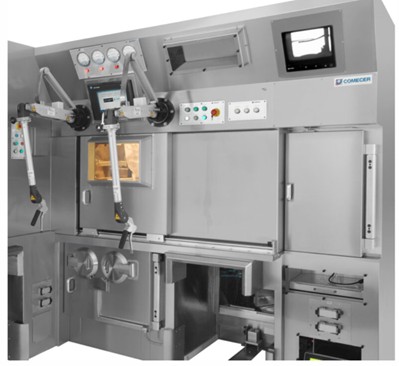
The easiest change that manufacturers can make to existing RABS and isolator filling lines is to replace glove ports and gauntlet gloves with either manual or electronic remote manipulators. These can be used on existing RABS or isolator filling lines.
Manual remote manipulators are currently being used to manufacture PET or radiopharmaceutical drugs. These manipulators can be designed as master-slave manipulators or command-remote manipulators (Figure 1). Master-slave manipulators are ball manipulators that have limited degrees of freedom and limited area coverage. Command-remote manipulators have wrist joints and grippers that approximate the dexterity of the human hand and fingers. These manipulators can be designed for various weight limits for lifting and can also be adapted to withstand repeated VHP and sporicidal contact to prevent microbial and particulate contamination in an ISO 5 filling environment.
There are also electronically controlled manipulators available, and these types of manipulators can have very precise positioning and can have cameras installed to focus on the work being performed (Figure 2). They perform very much like robotic arms, but they are not designed for repetitive tasks and are not programmed for specific tasks but rather they are controlled using hand actuators controlled by an employee.
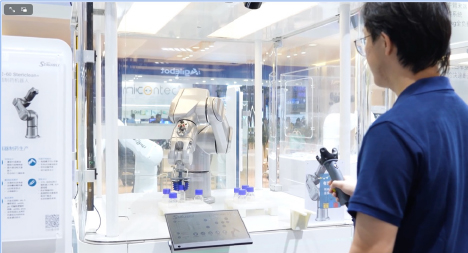
With all remote manipulator systems, careful design for purpose and employee training is crucial for successful implementation. Employee training can take weeks to master, but once the training is completed, employees can perform tasks within an isolator as if they were working with their hands. In one demonstration, an employee was able to successfully thread a needle using a remote manipulator with a camera for close-up work. I would envision that line setup, cleaning, and troubleshooting could easily be handled by such a manipulator.
Although the purchase of a remote manipulator system is initially more expensive than using glove ports and gauntlet gloves, the savings from not requiring the purchase of glove-port testers and time needed to test the gloves, frequent replacement of gauntlet gloves, reduction of downtime, and reduction in glove-leak investigations can more than offset the increased costs. In addition, employees have found the use of remote manipulators less fatiguing, more ergonomic, and easier to adapt to different employee heights and hand sizes.
In the long run, after having demonstrated success using remote manipulators, regulators could possibly allow a reduction in the use of media fills and sterility testing or a further reduction in area classification for rooms where isolator filling lines are operated, since human interventions are eliminated as a sterility assurance risk.
Conclusion
In Part 2 of this series, I will discuss the use of advanced sensors that can be installed on existing filling lines to detect equipment or component errors before they can cause a defective vial, syringe, or IV bag to be produced.
Part 3 of this series will examine the use of robotic systems for aseptic filling, where the industry is with their use, and where we can go in the future.
References
- U.S. Food and Drug Administration. FDA.gov recall database (search conducted June 6, 2025); https://www.fda.gov/safety/recalls-market-withdrawals-safety-alerts.
- U.S. Food and Drug Administration. 21 CFR 211.63 Equipment Design, Size, and Location, 2025; https://www.ecfr.gov/current/title-21/chapter-I/subchapter-C/part-211/subpart-D/section-211.63.
- European Commission. Annex 1: Manufacture of Sterile Medicinal Products, EudraLex – Volume 4 – EU Guidelines for Good Manufacturing Practice for Medicinal Products for Human and Veterinary Use, 2022; https://health.ec.europa.eu/system/files/2022-08/20220825_gmp-an1_en_0.pdf.