

Sterile Manufacturing Under Stress FDA and Industry Lessons from Hurricane Helene

On September 27, 2024, Hurricane Helene struck North Carolina with devastating force – a Category 4 storm with 137 mph winds and 30.8 inches of rain. Described as a 1-in-1,000 probability event, the heavy rain surge triggered extreme flooding at Baxter’s North Cove manufacturing facility.
The 1.4-million-square-foot site employs more than 2,500 people, is the company’s largest plant globally, and supplies about 60% of U.S. intravenous (IV) solutions. The event posed not only a site-level disaster, but a national public-health and IV fluid supply crisis.
The hurricane response unfolded as a large-scale, multi-agency recovery effort involving Baxter, the U.S. Food and Drug Administration (FDA), emergency management teams, and public health partners. The priority: restoring a sterile manufacturing facility inundated with mud and debris, thereby ensuring the U.S. IV fluid supply did not fail.
The response to the disaster was spotlighted in the opening plenary session, “Lessons of Recovery and Resilience: Pharma and the Aftermath of Hurricane Helene,” at the 2025 PDA Pharmaceutical Microbiology Conference.
Christiana Bielinski, Global Head of Quality Compliance at Baxter, described crisis management at the storm-stricken North Cove site and the steps required to restore sterile manufacturing operations. Emily Thakur, Senior Program Manager with the FDA Center for Drug Evaluation and Research’s (CDER) Drug Shortage Staff (DSS), provided a regulatory perspective, outlining the FDA’s role in managing drug shortages and supporting supply continuity.
From Floodwaters to GMP Control: Baxter’s Site Recovery
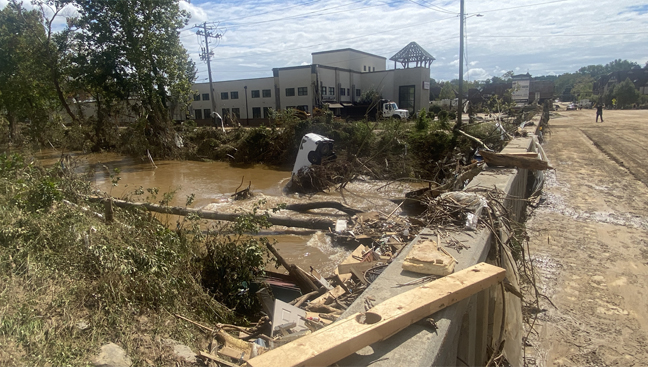
Baxter management activated North Cove’s natural-disaster preparedness plan even before Hurricane Helene made landfall, prioritizing three actions: a controlled evacuation to protect employees; a systematic shutdown of power and equipment to limit damage; and the relocation of more than 1,200 truckloads of finished product to higher ground – a move critical to maintaining supply continuity in the immediate aftermath.
Within 24 hours, a crisis response team arrived to assess the damage. “It was literally like a disaster zone,” Bielinski said on arrival at the facility. “There was mud everywhere, up the walls and clogging up aseptic suites. There was no light, there was no running water, there was no electricity – just an eerie sound of pallets cracking because of the water damage.”
Baxter contracted a remediation firm to focus on initial stabilization and cleanup. More than 3,600 workers were brought to the site, sleeping in trailers set up around the perimeter. The early days were dedicated to shoveling out mud, pumping water, and stripping out saturated materials.
This was followed by a far more complex task: restoring the facility to a state of GMP control for sterile manufacturing. Equipment was dismantled, decontaminated, and requalified; utilities were rebuilt. The environmental monitoring baselines underpinning aseptic manufacturing were re-established. Temporary laboratories were set up in mobile trailers to support basic microbiological testing, with additional analysis outsourced while in-house capabilities were rebuilt.
A central technical risk was the site’s water infrastructure. North Cove relies on an on-site aquifer to generate water for injection (WFI), and floodwater intrusion would have made production impossible. Although testing confirmed the aquifer remained intact, the storm disrupted commissioning of a new WFI system that had been intended to run in parallel with the existing loop. The new system could not be brought online, and the legacy system had to be rescued – drained, scrubbed, de-rouged, sanitized, and fully requalified – before any manufacturing could resume.
Post-intrusion decontamination also required vaporized hydrogen peroxide (VHP) gassing across the facility. Teams had to rapidly learn and validate the approach, running VHP cycles room by room.
Baxter focused initially on restoring the manufacturing lines most critical to patient care: one-liter IV solutions, the volume most commonly used in hospitals. By the end of 2024, 8 of North Cove’s 10 manufacturing lines – representing roughly 85% of pre-hurricane capacity – were back up and running. The final two lines restarted in January 2025, and the site had returned to its pre-hurricane production levels by February, just four months after Helene made landfall.
“In all, we estimate that more than 2.5 million man-hours went into cleaning, repairing, and restarting the facility,” Bielinski said. Patrizia Cavazzoni, former director of the FDA’s CDER, praised the “tremendous effort by the manufacturer,” noting that critical production was brought back online within 60 days, “which really is remarkable.”
Regulatory Flexibility in Practice: FDA’s Drug Shortage Response
FDA’s DSS is the office designated to oversee and facilitate the resolution of drug shortages, a role formalized in Manual Policies and Procedures 4190.1.
Typically, drug shortages in the U.S. arise from manufacturing and quality failures, including equipment breakdowns, aging infrastructure, sterility lapses, and supply-chain constraints. Sudden spikes in demand – such as the recent surge for GLP-1 weight-loss drugs – are another common driver. Natural disasters, by contrast, are far less common, but when they do occur, they activate the same drug-shortage response framework.
At its core, that framework depends on early notification. Under section 506C of the FD&C Act, Thakur stressed, DSS requires manufacturers to notify the FDA of manufacturing interruptions, discontinuations, or other events likely to lead to a meaningful disruption in supply. Once notified, the FDA works closely with manufacturers to address problems.
However, the FDA cannot mandate production increases, dictate distribution, or compel prioritization of supply. “We can advise, assist, and expedite inspections and reviews,” she noted, “but the manufacturer must address the root cause.”
Once notified by Baxter, DSS had to balance – as it does in all drug shortages – the need for regulatory flexibility to sustain supply against the risk of compromising patient safety or product quality. For the Hurricane Helene response, DSS drew from a broad regulatory toolbox to prevent the domestic IV fluid supply from collapsing.
Temporary Importation Authorizations: The FDA granted Baxter temporary authorizations to import IV solutions from nine of its global manufacturing sites that were not previously approved for U.S. distribution. To enable this, FDA teams conducted rapid, line-by-line reviews of foreign quality data packages, microbial control strategies, and inspection reports from the local regulators overseeing those facilities, ensuring patient safety before authorizing release.
In total, more than 50 IV and irrigation product codes were authorized from Baxter’s global network. The first shipments arrived in the U.S. within three weeks of the storm. By the end of 2024, nearly 18,000 tons of product had been flown into the country – the equivalent of more than 200 Boeing 747s – with federal partners supporting large-scale airlifts during what was the peak holiday cargo season.
Expiration Date Extensions: Regulators also worked with Baxter to extend use dates for a broad range of IV and irrigation products, supported by data from Baxter’s stability programs. Authorizations are provided for an additional 12 months, helping preserve usable inventory.
Expedited Reviews: Under section 506C of the FD&C Act, FDA expedited review of Baxter proposals, including site capacity assessments, restoration plans, and manufacturing changes needed to support recovery.
Pre-operational Review Meetings: In response to the crisis, Baxter and FDA improvised an entirely new process in real time: pre-operational review meetings. “I remember telling OPQ’s Derek Smith, ‘I have no idea how we structure this, or what we are going to do,’” Bielinski recalled. “And he leans in on the screen and goes, ‘We’ve never done it before either.’”
The review meetings became a forum in which both teams walked through readiness data, engineering controls, environmental trends, and restart plans together – replacing what would normally have taken days or weeks of sequential document exchange.
Compounding of IV Solutions: The FDA also issued guidance easing restrictions on the compounding of IV solutions, allowing hospitals and other facilities to supplement supply where appropriate, under defined conditions.
Drawing on these tools, DSS moved quickly. Within hours of Baxter’s early notifications, the agency assembled an internal crisis team spanning multiple FDA functions – including clinicians, scientists, OPQ, OMQ, and compliance – to review U.S. and non-U.S. data packages, assess foreign inspection histories, and evaluate supply and quality risks.
In parallel, DSS coordinated with partners across the Department of Health and Human Services (HHS), including the Administration for Strategic Preparedness and Response (ASPR), to assess clinical impact, review risk assessments for potentially usable products, and align broader emergency preparedness efforts.
“This was longer and a bigger lift than other shortages,” Thakur acknowledged. As such, FDA mobilized a dedicated, cross-functional team that remained focused exclusively on IV fluids throughout the recovery period, rather than distributing work across rotating teams.
Reviewers set aside other assignments and stayed on the case from start to finish, working together daily. That continuity enabled faster decision-making, consistent risk assessment, and real-time situational awareness, thereby accelerating recovery.
Lessons on Recovery, Resilience, and Regulatory Flexibility
Beyond restoring supply, the scale and coordination of the remediation effort yielded important lessons for industry, the FDA, and the broader pharmaceutical manufacturing community on how drug shortages are prevented, managed, and mitigated – regardless of their root cause.
Transparency and Communication: Stressing that “early notification is key to the prevention of drug shortages,” Thakur emphasized that regulatory flexibility can only function when grounded in transparency and early, candid communication.
In response to Helene, Baxter immediately notified hospital customers and government agencies that an IV fluid shortage was likely, enabling customers to manage existing supplies and triggering rapid regulatory mobilization. Once alerted, DSS initiated its standard shortage response: monitoring supply and demand across the U.S. market, coordinating internally among CDER offices, and working directly with the manufacturer to assess options to mitigate the impact on patients.
This emphasis on early engagement is increasingly formalized. Under the CARES Act of 2020, the FDA now requires risk management plans for certain products, including advanced contingency planning for manufacturing failures or sudden demand surges.
Capacity versus Redundancy: Hurricane Helene spotlighted an operational reality: for products such as IV fluids, the supply chain has almost no built-in redundancy. Unlike some other critical medical products, there is no national stockpile of IV fluids. Supply continuity, therefore, depends almost entirely on manufacturing capacity and distribution resilience rather than reserve inventory.
The storm brought this structural vulnerability into sharp focus, exposing the risks of concentrating IV fluid production at a single manufacturing site. From a resilience perspective, redundancy can be introduced in several ways, including standing up an additional facility, qualifying a second aseptic line, maintaining “warm” capacity, or securing validated alternative suppliers.
However, introducing redundancy at any level poses significant challenges, often requiring capital investment, access to specialized aseptic manufacturing expertise, careful siting decisions, and navigating complex regulatory approval pathways.
The economic reality is stark: the market simply does not pay for resilience. The sterile injectables sector operates under intense pricing pressure, with thin margins, high fixed costs, limited pricing flexibility, and competition centered on volume.
Even maintaining reserve capacity or inventory buffers carries ongoing costs that are difficult to justify under normal operating conditions. Bielinski described manufacturers as operating largely “hand-to-mouth,” balancing the pressure to keep products affordable against the costs of planning for contingencies that may never be used.
Climate Risk and Infrastructure Vulnerability: Hurricane Helene also reinforced a critical lesson for pharmaceutical manufacturing: extreme weather can no longer be treated as a rare edge case in infrastructure risk planning. Hurricane Maria, which made landfall on Puerto Rico on September 20, 2017, exposed similar vulnerabilities, triggering widespread IV fluid shortages that the sector had not fully recovered from by the time Helene struck.
As storms become more frequent, more intense, and more disruptive, strategic planning increasingly requires fresh thinking about site selection and manufacturing footprint, infrastructure investment, and contingency planning.
Aligning Economics, Regulation, and Resilience: The Helene response raises broader questions about how economic viability, regulatory frameworks, and industrial resilience can be better aligned to ensure a continuous supply of essential medicines.
Manufacturing network design, alternative-site readiness, and capability planning represent practical opportunities to move resilience considerations earlier in the development and lifecycle management process. Increasingly, these efforts are supported by improved supply-chain visibility and automation, enabling manufacturers to better assess capacity constraints and respond more rapidly to disruption. Bielinski proposed that such preparedness decisions be articulated more explicitly within regulatory filings, allowing FDA and manufacturers to share an upfront, realistic understanding of what alternative capacity can be mobilized in an emergency.
While these approaches would not eliminate the economic challenges inherent in low-margin sterile injectables, they could help shift resilience from emergency improvisation toward a more deliberate, system-level design choice.
Conclusion
The response to Hurricane Helene underscored that resilience in sterile injectables is not something any single manufacturer or regulator can deliver in isolation. It is an emergent property of the intersection between economics, regulatory frameworks, manufacturing networks, and risk planning.
While the event exposed enduring vulnerabilities, it also demonstrated that early communication, regulatory flexibility, and coordinated execution can avert prolonged supply disruption – even under extreme conditions.
As climate volatility, geopolitical disruption, and manufacturing concentration continue to intensify, the Helene response offers insight into the regulatory and operational dynamics that will increasingly shape the continuity of pharmaceutical supply chains.
About the Author
-

Anya Hillery, PhD, Freelance Medical Writer
Dr. Anya M. Hillery is a freelance medical writer, as well as Senior Editor at International Pharmaceutical Quality. She received her BSc in pharmacy from Trinity College Dublin, Ireland, and completed a PhD and post-doctoral research in nanoparticle delivery systems at University College London, UK. She led her own nanomedicine research laboratory at the University of Brighton in the UK. She later served as a Professor of Health Sciences and Vice Dean at Saint Louis University's Madrid campus in Spain. Now based in Washington, D.C., she focuses on emerging trends that are shaping the future of advanced therapeutics.