
PDA Virus Conference 2026
Expanding Scopes and Advancing Viral Safety
22 - 23 June 2026 / Vienna, Austria #pdavirus
Final PDF Poster Submission must be received by 08 May 2026 for consideration.
Poster SubmissionTimeline
-
Final PDF Poster Submission Date
08 May 2026
Deadline for final printable PDF submission
Each abstract must include the following information to be considered:
- Presentation Title
- Presenter's Name And Contact Details
-
Presenter's Biography
(Approx. 100 words) -
Additional Speakers
(If applicable) - Key Objectives of Topic
-
2-3 Paragraph Abstract, Summarizing the Topic
(Max 200 words)
General Information
Abstract submitters may submit up to two entries for consideration.
All presentations must be free of commercial intent. Incomplete proposals will not be considered.
Call for Posters/Case Studies


Types of Submissions
Poster
Accepted posters will:
- Be displayed in the exhibit hall and might be a part of the guided poster walk
Get the Attention you deserve!
Maximize your visibility by contributing a podium or poster presentation at PDA Virus Conference 2026. Leverage this unique opportunity to highlight your work at the event. Posters will be available online post-event.
Topics we are looking for:
- 1. Regulatory Updates
- International Perspectives
- Global Pharmacopoeia and Guidance Chapters
- Implementation of ICH Q5A(R2) Guideline
- Regulatory Requirements for Virus Safety Testing and Virus Clearance Studies
- Impact of Regulatory Requirements on the Pharmaceutical Industry
- Inclusion of Next Generation Sequencing in Regulatory Submissions
- 2. Current and Emerging Viruses
- Hepatitis E Virus
- Parvoviruses
- Coronaviruses
- Zika
- West Nile
- Swine Flu/Avian Flu
- Measles
- Ebola
- Mpox
- Circovirus
- Zoonoses
- 3. Virus Safety of Starting and Raw Materials
- Risk Assessment
- Virus-Like Particles
- Case Studies for Media Treatment
- New Threats to Human Plasma
- Cell Culture Media Treatment/Cell Substrate Safety
- Raw Materials and Material Selection
- Substances of Human Origin and Animal-Derived Material
- Supplier Audits and Qualification
- Cell-Selection Antibodies
- Serum and Trypsin
- Antibody Drug Conjugates
- Adventitious Viruses/Adventitious Agents
- Prevention of Contamination
- Utilization of Prior Knowledge
- Plant-based Material
- 4. Viral Safety in Manufacturing
- Case Studies and Experimental Data
- Risk Assessment
- Biopharmaceuticals
- Plasma-Derived Medicinal Products
- Viral Vaccines
- Irradiation (Gamma, Electrons, X-rays)
- Inactivation and Removal Performance
- Filtration/Nanofiltration
- Prion-Specific Filtration Methods
- Viral Clearance Strategy: Removal, Inactivation, and Testing
- Design Space for Process Optimization
- Downstream Processes/Chromatography
- Sustainable Detergents
- Precipitation
- Prior Knowledge and Risk Assessments
- Continuous Manufacturing/Continuous Processing
- Platform Approach
- Impact of PFAS Regulation
- Technical Developments/Innovation/Emergent Technology
- Integrated Recycling Process
- Reduction of Wastewater
- Waste Prevention and Handling
- Environmental Protection
- Recycling Economy
- Data Acquisition and Standardization
- 5. Virus Testing
- Virus Detection Methods
- Virus-Like/Noninfectious Particles
- Development of Alternative and Rapid Test Methods
- Next Generation Sequencing/High Throughput Sequencing
- Technical Operation of Platforms (e.g., Assay Automation, Time to Result, Validation)
- Bioinformatics, Data Analytics, and Application of Artificial Intelligence
- In-silico Standards for Bioinformatics Software
- Machine/Deep Learning on Virus Sequences
- Targeted vs. Non-Targeted Next Generation Sequencing
- Product-Enhanced Reverse Transcriptase Assay
- Nucleic Acid-Based Methods
- Digital Polymerase Chain Reaction
- Model Organisms, Equipment, and Conditions
- Replacing In-Vivo Assays and the 3R Initiative
- Replacing/Complementing In-Vitro Assays
- Cell-Based Assays/Hepatitis E Virus Infectivity Assay
- Emerging and Hard-to-Detect Viruses
- Transmission Electron Microscopy
- 6. Viral Safety of ATMPs and Modern Therapies
- Human Platelet Lysates and Sera
- Viral Vectors/Viral Vector Products
- Virus Panels/Virus Selection
- Virus Safety for Different Cell Lines
- Helper Virus Production
- Viral Clearance and Viral Vector Purification Processes
- Case Studies for Cell and Gene-Based Medicinal Products
- Considerations for Induced Pluripotent Stem Cell Therapies
- Extracellular Vesicles
- Risk Management Strategies
- Transplantation and Xenotransplantation
- Reduction of Vein-to-Vein Time
- Application in Medical Devices
- 7. TSE Contamination and Risk Mitigation
- Raw Materials
- Blood/Plasma Products
- Cell-Based Products
- Cell Substrates and Their Infectability
- New Concepts for Testing and Identification
- Inactivation Strategies and Equipment
- 8. Aspects of Food and Waterborne Virus Safety
- Norovirus-Related Diseases
- Rotavirus-Related Diseases
- Identification of Viruses in Food Matrices
- Cultured Meat Products
- Transmission Pathways
- Risk Assessments
- 9. Virus Reduction Studies
- Virus Safety Strategies
- Usage of Prior Knowledge
- Design of Studies and Design of Experiment Studies
- Platform Validation Including Modular Claims
- Mechanism of Action of Virus Removal/Inactivation
- Robustness of Specific Unit Operations
- Identification of Critical Process Parameters
- Spike Preparations
- Co-Spiking Studies
- Scalability of Study Design and Results
- Sanitization of Chromatographic Equipment
- Columns Including Virus Carry-Over Studies
- Impact of Virus Spike Quality
- Developments in Laboratory Automation
- Viral Reduction in Alternative Cell Types
Poster Information
All posters will be printed by PDA and displayed as part of the exhibition.
Please send your final printable PDF file and poster title to [email protected].
Important
Poster presenters are required to pay a full conference registration fee.
Join our guided poster walk in our exhibition hall and gain more visibility. You will have the chance to engage with our audience!
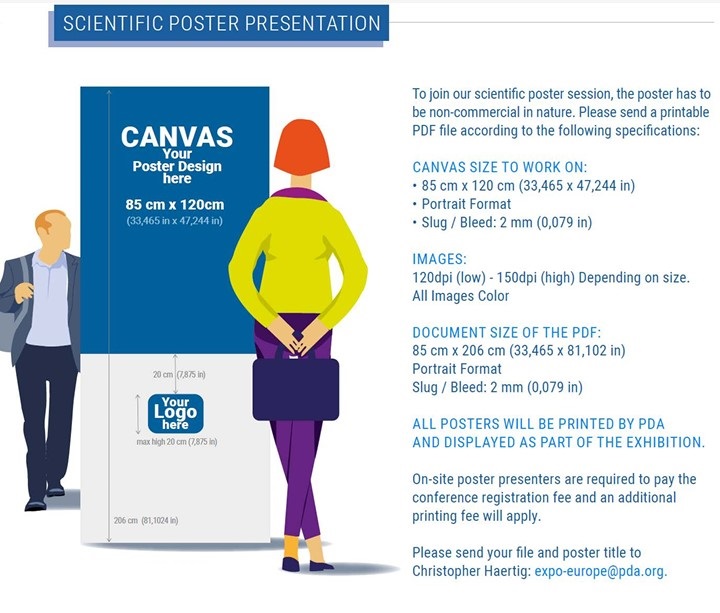
Poster Display Dimensions
Please find the PDF dimension requirements below:
Exhibition and Sponsorship Opportunities
PDA is seeking vendors who provide products/services in support of this conference. Space on-site is limited and is on a first-come, first-serve basis.
Exhibition: 22-23 June 2026
To reserve your space, please contact Christopher Leisterer-Haertig at [email protected].