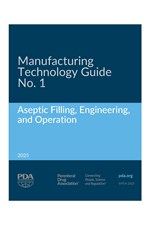
Manufacturing Technology Guide No.1: Aseptic Filling, Engineering, and Operation
- Published
- Oct 2025
- ISBN
- 978-1-945584-52-7
- Pages
- 281
- PDA Item Number
- 43594
Premium Members: to claim your annual free technical document download, email [email protected] and indicate the document you wish to claim.
- Format
- PDF Single User
- Member Price
- $180.00
- Nonmember Price
- $325.00
- Government Price
- $180.00
Please sign in or become a member to purchase items from the PDA bookstore.
The PDA Manufacturing Technology Guide No. 1: Aseptic Filling, Engineering, and Operation is designed to communicate the Parenteral Drug Association’s thoughts on the topic and encourage further dialog among industry, health authorities, and suppliers of technology and materials, taking into consideration the changes and needs of the modern, global, sterile, healthcare product manufacturing industry. It does not represent an industry standard or regulatory guidance. This document addresses topics relating to major technologies for sterile filling and extends to the point of container closure, with the aim of discussing key considerations, risk and benefits of each technology.
This guide provides an overview of the elements that should be considered in the selection of an appropriate filler technology and for the successful integration of the filling system into the broader aseptic operation. Precautions with regard to sterility assurance (SA) are paramount for both liquid and powder filling systems. Innovation in filling technology continues throughout the industry in an effort to improve filling precision, increase throughput, reduce the need for interventions, and improve SA. This document will serve as a comprehensive resource for the considerations and components to be included in any design project.
Table of Contents
- 1.0 Aseptic Filling System Design Elements
- 2.0 Aseptic Filling Technologies
- 3.0 Filling Needle Designs
- 4.0 System Functionality and Design Choice
- 5.0 Designs for Dose Control Systems
- 6.0 Special Considerations for Advanced Container–Closure Design and Implementation
- 7.0 Closures and Closing System Design
- 8.0 Microbiological Risks for System Operation
- 9.0 Component and Filling Supply Handling Considerations
- 10.0 Material Transfer System Design
- 11.0 Sterile Filtration and Filling System Considerations
- 12.0 Discard Strategies for Aseptic Filling of Liquids
- 13.0 Considerations for the End of the Aseptic Fill Unit Operation
- 14.0 Filling System and Environmental Considerations
- 15.0 Utility Considerations for Aseptic Operations
- 16.0 Filling Systems for Powder Filling
- 17.0 Product Characteristics Compatibility for Vacuum Pressure Powder Filler and Auger
- 18.0 Effect of Powder Transfer on Technology Selection
- 19.0 Discard Strategies for Aseptic Filling of Powders
- 20.0 References
- 21.0 Appendix 1: Liquid Filling Case Studies
- 22.0 Relevant Vendor and Supplier Resources
About the Authors
- Rebecca Brewer, Quality Executive Partners (retired) (Co-Lead)
- Mauro Giusti, Eli Lilly Italia (Co-Lead)
- Matthias Angelmaier, Pharmaplan
- Alessandra Benassi, IMA S.p.A.
- Peter Buus, Novo Nordisk
- Alessandro Ciacco, CAI
- Richard Denk, Skan
- James Drinkwater, Ziel
- Basem Gerges, groninger & co. gmbh
- Nicola Giardini, Marchesini
- Frank Haeterich, Bausch+Stroebel
- Pia Johansen, Novo Nordisk
- Kevin Lavin, Bristol Myers Squibb
- Roberto Montuschi, IMA S.p.A.
- Laura Moody, PhD, Syntegon
- Dan O’Mahony, MSD
- Philip Osterhaus, M&O Perry Industries, Inc.
- Giacomo Paglini, ACS Dobfar S.p.A.
- Julian Petersen, groninger & co. gmbh
- Nico Schillebeex, Johnson & Johnson
- Justin Svec, Eli Lilly & Company
- Axel Wagner, OPTIMA Pharma GmbH
- Patrick Wieland, Bausch+Stroebel
- Andrea Zanotto, IMA S.p.A.